

 CN
CN



 Fill out a inquiry form




Horticulture Lighting Modular 48V Spectrum Control with Lumissil LED Drivers and MCUs
Horticultural LED grow lamps enable food production in a controlled environment, often close to large markets in urban centers. To optimize crop yield across different growth stages, these systems must deliver a mix of light wavelengths, photon densities, and exposure schedules. A tunable grow lamp will combine blue, red, white and amber LEDs along with specialized UVA or UVB treatment channels. Because each LED type has a different forward voltage, operating current, thermal behavior and plant exposure requirements, the lamp would benefit from independent constant‑current switching regulators and a supervisory controller (MCU). Together, they enable the automated execution of highly specific, repeatable “light recipes.”
WAVELENGTHS FOR SPECIFIC PLANT RESPONSES
The sun delivers a continuous, full spectrum of light but is subject to environmental fluctuations. Sunlight includes everything from deep ultraviolet (UVB, UVA) through the entire visible spectrum, and deep into infrared (heat). Traditional high‑intensity discharge (HID) lamps approximate portions of this spectrum but they lack spectral control and radiate much heat. In contrast, horticultural LED lamps are meant to output only the effective and plant specific wavelengths. This targeted approach delivers a stable, predictable flow of photosynthetic energy that remains consistent from morning to night, enabling highly repeatable and standardized crop production cycles.
LED technology allows the spectral output to be tailored toward wavelengths that support specific plant responses, while minimizing energy delivered outside the intended light recipe. Each wavelength is selected for a specific horticultural role, working together to support photosynthesis, improve canopy penetration, and influence plant development from early vegetative growth through flowering and final crop yield.
SELECTING THE RIGHT HORTICULTURAL SPECTRUM
Since plants respond to photon count rather than human‑perceived brightness, radiant flux and photon flux are the critical metrics for horticultural LEDs not lumens. Far‑Red, Hyper‑Red, Deep Blue, Horticulture‑White, Amber, UVA, and UVB wavelengths each contribute differently to photosynthesis, plant morphology, canopy penetration, pigmentation, and stress‑response mechanisms. The final LED‑string design should therefore be based on the selected wavelength, optical or photon output, forward‑voltage bin, and operating current, with appropriate derating for junction temperature, optical losses, aging, and system‑level derating.
THE ADVANTAGE OF SWITCHING LED DRIVERS
Because commercial grow lights may operate for 12 to 20 hours per day, maximizing electrical efficiency and managing thermal dissipation are critical design parameters. Thermal loss becomes significant when many high‑current LED strings with different forward voltages are not efficiently regulated. The resulting elevated temperature increases heatsink requirements, lowers LED life expectancy, and adds to the cooling load of a greenhouse, ultimately increasing electricity costs.
A switching LED driver regulates current by transferring energy through an inductor and a switching power stage. Depending on the difference between the available DC voltage rail and the required LED string forward voltage, designers can implement buck, boost, buck‑boost, or SEPIC topologies. Because this switching method significantly reduces power conversion losses, it can deliver higher electrical efficiency compared to traditional linear regulators.
AVAILABLE LUMISSIL SWITCHING LED DRIVERS
Lumissil is a major supplier of LED driver ICs with a broad portfolio serving automotive, industrial, consumer, and specialty lighting applications. Its switching LED driver family stretches from compact integrated synchronous buck devices to flexible multi‑topology drivers. This range gives horticultural lighting designers options for efficient constant‑current regulation, high‑current LED strings, wide input voltage operation, independent spectral channel control, PWM and analog dimming, digital programmability, and system diagnostics. Table 1 below highlights several Lumissil switching LED drivers that are well suited for modular, multi‑wavelength horticultural lighting systems.
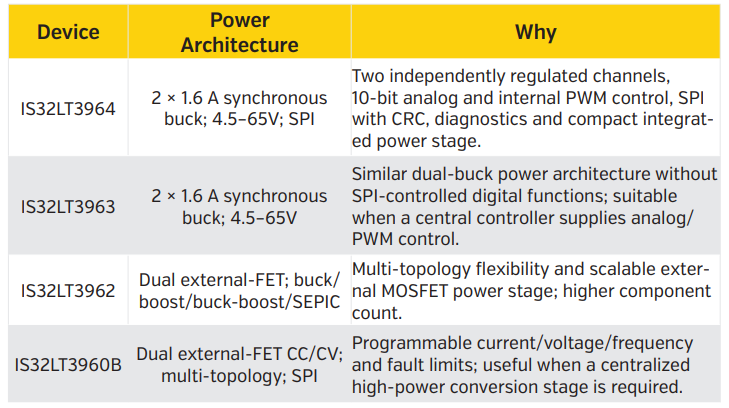 Table 1. Dual Channel Switching LED Drivers for Horticulture Lighting
In the 48V modular grow lamp architecture shown in Figure 1, the IS32LT3964 provides the best balance of power density, digital control and diagnostics. Although each channel supports up to 1.6A, this example operates the LED strings at 350mA, leaving substantial current capability for designs requiring higher‑power strings. Each device integrates two independently regulated synchronous buck channels, allowing two separate spectral LED strings to be driven from the common 48V DC bus. Using the device’s SPI interface, a central spectrum control MCU such as the IS31CS9202 can program channel current and PWM settings across multiple IS32LT3964 modules, simplifying the wiring architecture by replacing numerous dedicated analog or PWM control lines with a shared digital control bus.
Driving eleven IS32LT3964 devices over SPI in a compact system with 22 simultaneously switching buck channels creates a challenging board‑level transient noise environment. The IS32LT3964 enhances communication robustness by incorporating CRC protection on its SPI interface, reducing the risk that noise induced bit errors alter current or PWM register settings.
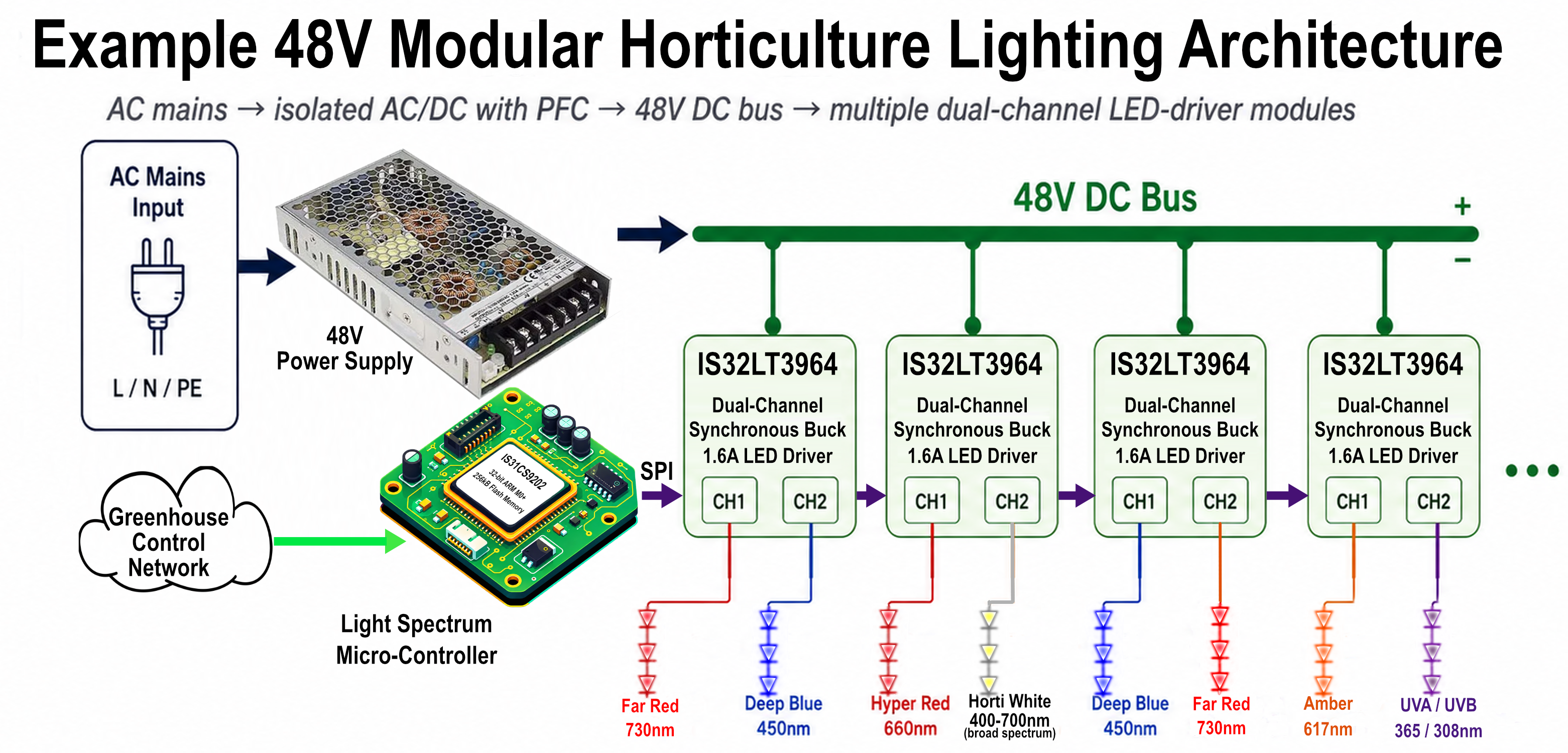
Figure 1. Intelligent grow lamp architecture
IS31CS9202 FOR AUTONOMOUS SPECTRUM CONTROL
The IS31CS9202 can turn the grow lamp from a fixed output lighting system into an intelligent, autonomous spectrum control platform. The MCU contains an ARM Cortex M0+ core, 256 kB ECC embedded Flash, 8 kB of both data and DMA SRAM. It also provides SPI, I²C, UART/LIN, CAN FD, PWM, ADC resources and a dedicated SPI Flash Controller intended for fast access to external LED configuration and pattern data.
In the horticultural lamp architecture, the IS31CS9202 acts as the central light spectrum controller, storing crop and growth stage specific lighting recipes and coordinating the current level, PWM duty cycle, and operating schedule of multiple IS32LT3964 channels. This enables independent control of far red, hyper red, blue, horticulture-white, amber, UVA, and UVB illumination throughout the photoperiod. The MCU can also provide closed-loop sensor control, manage daytime light integral (DLI) and UV exposure, implement thermal derating and safety functions, and connect the lamp to a higher-level greenhouse or facility control network.
MEMORY ALLOCATION FOR LIGHT RECIPES
For most horticultural control applications, the MCU’s 256kB internal ECC Flash will hold both the executable firmware as well as the embedded light recipe tables. Because these recipes are highly structured and compact, they can easily reside in the 256kB Flash. With a 16-hour photo period, a lighting recipe can be defined by a small number of scheduled events; such as sunrise ramp, daytime intensity, UV treatment window, sunset ramp, and OFF time, rather than storing discrete intensity values throughout the day. This event-based approach minimizes memory requirements while allowing the IS31CS9202 to store multiple crop and growth stage-specific spectral recipes alongside the control firmware.
EXAMPLE OF AN 11-DRIVER, 48V MODULAR GROW LAMP
The example grow lamp architecture uses eleven IS32LT3964 devices to provide 22 independently controlled constant-current LED channels, operating at 350mA per string. As summarized in Table 2, the spectral mix is weighted toward hyper-red for high spectral-balance control, with a smaller deep-blue component, supplemental horticulture-white and amber channels, and independently controlled UVA and UVB channels for programmed UV exposure.
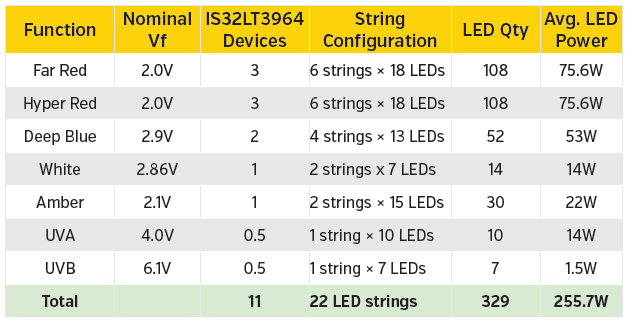 Table 2. Example IS32LT3964 Channel Allocation and LED Power Budget for a 48V Horticultural Grow Lamp
The LED strings consume approximately 255.7W at the stated operating conditions. Assuming 94% efficiency for the IS32LT3964 switching stages, the LED driver modules draw about 272W from the 48V rail, corresponding to about 5.67A. If the centralized isolated AC/DC supply is also assumed to operate at 94% efficiency, the estimated AC input power is about 289.4W. Therefore, a 350W isolated 48V AC/DC supply provides enough design margin for the spectrum control electronics, component tolerances, thermal derating, LED forward voltage variation, conversion losses, and possible increases in UV operating duty cycle.
CONCLUSION
A successful grow lamp combines photobiology, optics, thermal design, power conversion and control. Because plants are driven by photon wavelength, density, and dose rather than human-perceived brightness, precise spectral control is a necessity. Switching LED drivers provide efficient constant current regulation for independent control of multiple spectral LED strings, allowing the LEDs to convert electrical power into targeted photosynthetic wavelengths while minimizing power conversion losses and heat compared with less efficient legacy HID grow lamp technologies.
For 48V modular designs, the IS32LT3964 is ideal for the power stage, offering dual high current synchronous buck channels, fine analog/ PWM dimming, and SPI driven control. Adding an IS31CS9202 MCU to these drivers creates an intelligent spectrum controller capable of storing and executing crop-specific light recipes, monitoring fixture conditions and coordinating timed UVA/UVB treatment. Its 256kB ECC Flash is sufficient for typical control firmware and many light recipes, while the dedicated external SPI/QPI Flash controller provides a path to larger recipe libraries and logging storage.
The result is an architecture that delivers a scalable plant production platform that is engineered to deliver the right photons, at the right intensity, for the right duration and to the right part of the plant canopy.
Get Started on Your Next Horticulture Design:
Contact your local Lumissil representative today to request evaluation boards and sample ICs.
About Lumissil Microsystems
Lumissil Microsystems specializing in analog/mixed-signal products for automotive, communications, industrial, and consumer markets. Lumissil's primary products are LED drivers for low to mid-power RGB color mixing and high-power lighting applications. Other products include audio, sensors, high-speed wire communications, optical networking, and application specific microcontrollers. Lumissil Microsystems has worldwide ofices in the US Taiwan, Japan, Singapore, mainland China, Europe, Hong Kong, India, and Korea.



 analog@lumissil.com